Macquarie: Goliath
Replacing a 28-year-old broker portal inside Corporate Asset Finance, and cutting the rework on every deal by more than a third.
The problem
Goliath, the dealer portal brokers used to submit asset finance deals, was 28 years old, and its users thought it was the best in the market. For the bank it was costly, buggy, and built on a front end about to lose security support. The brief: act fast, no downtime, with the Royal Commission in the background.
We started with the people, not the screen: 30 contextual interviews recorded where the work happens, plus 7 expert interviews, with brokers, internal introducers and dealers on one side, and compliance, legal, risk and credit on the other. Three findings changed the brief: 80% of customers worked paper-first on quote and application, every application was reworked 3.4 times, and expenses were rarely accurate. Garbage in, garbage out.
Brokers loved the old portal because they could play it. They gamified margins and deals, overwrote rules, and used paper because they had not yet decided which lender would pay more.
The approach
Three principles the whole team could argue from: learn the workaround before you replace it, replace the tool not the instinct, and forgiveness. No dumb users, only dumb products. Brokers' paper, overrides and own dashboards were signals, not bugs.
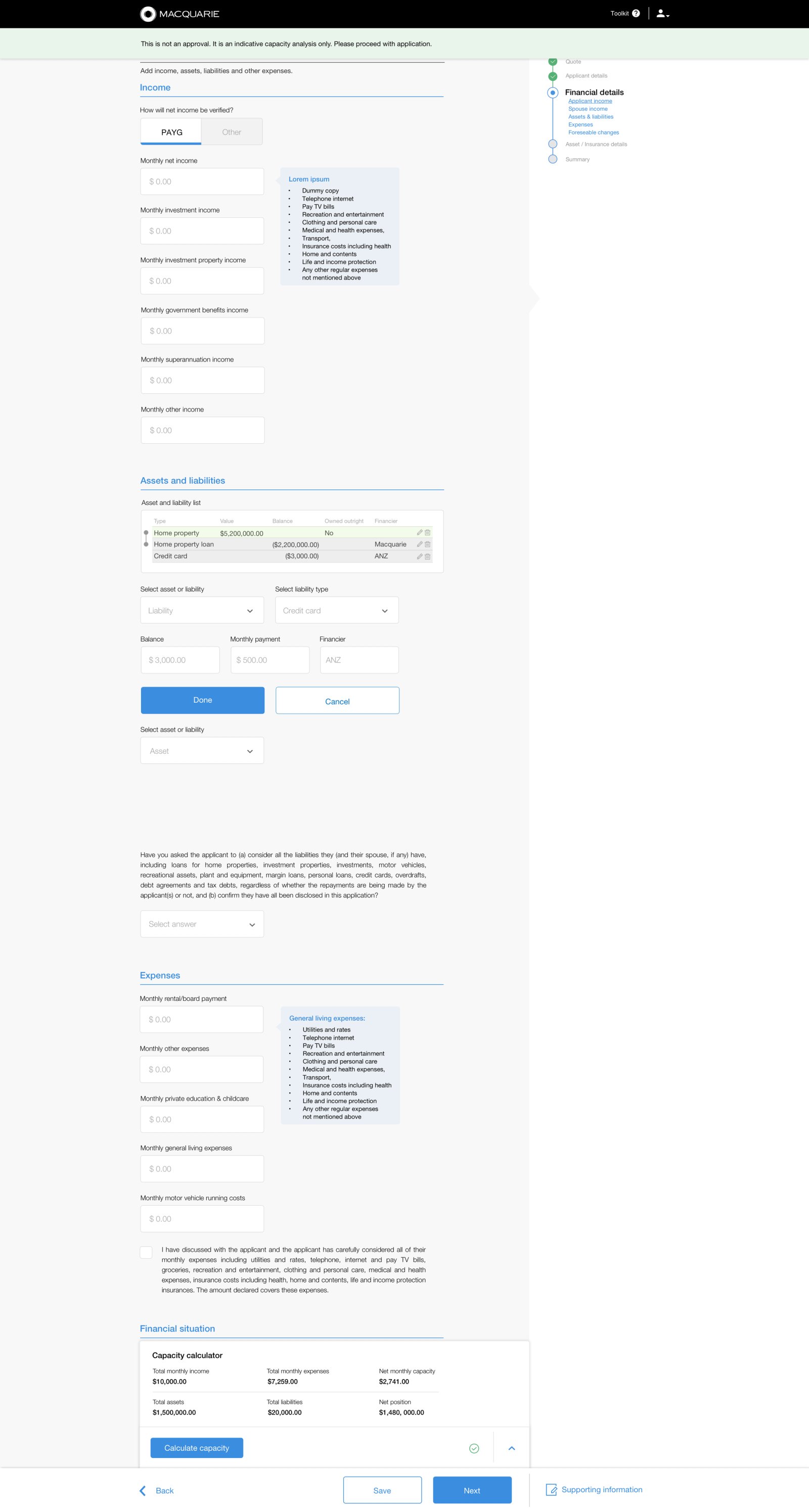
Instead of designing in documents, I built a prototype in code so brokers could test a real interface early, and so feedback was about behaviour, not opinions. The cost: a code prototype leaves little documentation for the next team. What it bought: learning early from a real interface, and delivery a few months ahead of plan.
The hardest call was cutting the dashboard, the feature business stakeholders thought most valuable. Every user we observed already had one in their own company, and nobody cared about a fancy one from Macquarie. I challenged the assumption with what we observed and the research, and the evidence carried the decision. The effort went into fast data entry instead: progressive disclosure only to set the path, the rest of the form built for speed.
Leading the team
I led a design team of three, in a room with about six executives and a sponsor, sharing roles with technology, product, compliance and legal. Freedom, air cover and clear direction: I took the pressure from the business so the designers could keep working, and cascaded a clear summary of the direction and the tensions, leaving out what could not be disclosed, so the team always knew the context their work sat in.
What shipped
A new quote submission platform, soft-launched to measure real adoption before any fanfare. Rework per deal fell from 3.4 to just over 2, and time to yes went from two days to one hour.
That last number was almost too good: brokers felt a one-hour approval was not a real approval, so we deliberately slowed the visible response to 24 hours. Time to yes matters most to brokers after commission, and trust is a design material, not just a metric.
What I'd do differently
I spent too long on a conversational way to fill the form, a lot of testing and code for very little impact. The lesson I keep: test the idea with a cheap prototype before building it. Accessibility and usability standards stayed very high throughout, and quality never slipped.